


From school mediation to peacebuilding: a 19-year journey

How Elizaveta Koval's journey began, from a regular school student to an expert in youth work and a specialist in the field of mediation and peacebuilding.
Today, Elizaveta Koval is a member of the Ukrainian Community of Dialogue Practitioners, a dialogue facilitator, a trainer in dialogue practices, a school mediator, a trainer and methodologist in the All-Ukrainian educational project Peaceful School, co-author and compiler of the module “Prevention of Bullying” in the online course from the Ministry of Education and Science of Ukraine “ Countering and Prevention of Bullying in Educational Institutions ”. Developer and trainer of the courses for teenagers “Young Peacemaker”, “Peaceful Conflict Resolution Skills”, “ Recovery and Resilience ”, “ Renew Yourself ”, which were attended by 150+ participants in total. She has conducted more than 30 offline trainings for teenagers in the areas of “Basic Skills of a School Understanding Service Mediator”, “Training of Facilitators for School Understanding Service Mediators”, “Restorative Practices for Teenagers”


Lisa’s journey into restorative practices began in a regular school classroom: “ When I was only 12 years old, in 2007, I attended my first peer mediation training. It was a moment that radically changed my perception of relationships, authority, and my own voice. The schools of my childhood were a territory of strict hierarchy. Adults always knew “how to do it best,” and any deviation from the rules was punished with a public reprimand. Despite the fact that I was a “well-behaved child,” I acutely felt the pressure of this system. It seemed unfair to me that no one asked the child about the reasons for his actions, did not look at his needs, did not try to adapt the teaching so that it was inspiring. Mediation training was my first experience of a restorative approach. For the first time, I, a 12-year-old teenager, was treated as a conscious individual. My opinion was asked, my emotions were validated, and my needs were recognized as important. It was something extremely humanistic: mediation opened up a world for me where conflict is not a reason for punishment, but an opportunity for dialogue and finding solutions that satisfy everyone. Although my school never had an official Reconciliation Service, the ideas of the restorative approach stayed with me. I began to implement peaceful conflict resolution skills in my daily life and implement my own projects, even without the support of the administration.” - Lisa shared her memories

A year later, in 2008, Lisa completed a trainer training course, when she was only 13 years old. She recalls feeling very nervous and scared during her first training for teenagers, which even made her cry in front of the group. But this episode was a turning point: instead of condemnation, the young specialist received support from students and supervisors, which helped her gain experience that it is okay to make mistakes. “This finally convinced me: the restorative approach* is what I want to dedicate my life to,” Lisa says .

During her studies at the university, Lisa continued her work as a trainer, introducing a restorative approach to building relationships in the school environment. A key stage was cooperation with the Institute of Peace and Understanding (IPI) - pioneers of school mediation in Ukraine. An important role in Lisa's development as an expert was played by her father, Roman Koval - a leading Ukrainian mediator, facilitator with international experience, who worked at the World Bank, Chairman of the Board of the NGO IPI (2000-2022). Lisa had the opportunity to observe the work of specialists - Roman and Alena Horova, who introduced and developed mediation in Ukraine, including through the creation of School Understanding Services. For a long time, the team of the Institute of Peace and Understanding lived a dream of a wider impact, because they saw that students quickly master the principles of mediation and dialogue, but, returning to the classroom, they again encounter the authoritarian system of teachers and parents. It was clear that it was not individual children who needed to change, but the entire school ecosystem. In 2018, this dream was realized in the Peace School project, where Lisa took on the position of Peace Building Advisor. Thanks to long-term successful practice and visible results, the Ministry of Education and Science of Ukraine approved the Peace School model for use in the educational process to improve relationships and peacefully resolve conflicts. It was a large-scale work: the project team accompanied the schools for three years, working simultaneously with the administration, teachers, parents, and students. And in her new role, Lisa Koval became part of the expert group, developed supervision tools, trainings, and methodologies within the framework of a restorative approach. She began working directly with hundreds of people, helping them overcome challenges — from conflicts to professional burnout. With the onset of the full-scale invasion, the project team, together with school mediators, adapted tools for psychological self-support and resilience in wartime, and disseminated them, in particular, through online courses for adolescents “Recovery and Resilience” and training in a trauma-sensitive approach for teachers.
During her collaboration with IMiP, since 2019, Lisa has expanded her audience and started working with students and youth under 30. A special place in this experience is occupied by the international summer school “ Europe as a Peacebuilding Project ”. A team of Ukrainian-German participants together explored the EU’s experience in peacebuilding and the possibilities of cooperation in this direction. This was long before the topic of “peacebuilding” became mainstream in the media. Among the participants were veterans of the ATO and internally displaced persons, which gave the discussions special practical importance. In addition to the international project, Lisa also began cooperation with youth centers (in particular, Chernivtsi). Later, during the full-scale invasion, dialogue practices helped local authorities and communities more effectively integrate displaced persons and reduce tension in society. Another example is the Her Perspective project (in collaboration with UN Women), which enabled young displaced women to describe their experiences through video, documenting a living story of resistance and resilience.
The power of the restorative approach and youth as an engine of change
And yet, why youth? First of all, it was my own feeling of how much the restorative approach has a strong impact on young people. Getting acquainted with dialogic practices from school and student days is about finding internal resources and developing one's personality. Lisa Koval still maintains contact with students from the Peace School era and sees how the restorative approach has shaped their lives: relationships, approaches to learning and professional activity. These young people consciously create a peaceful environment around themselves that promotes cooperation and constructive conflict resolution. According to Elizabeth, working with youth is a fundamental contribution to a sustainable society. Young people have enormous energy, are open to restorative practices, and are not burdened by stereotypes that take root with age. These are people who strive to use an interest-based approach as an integral part of their lives.
Role in the Ukrainian Community of Dialogue Practitioners
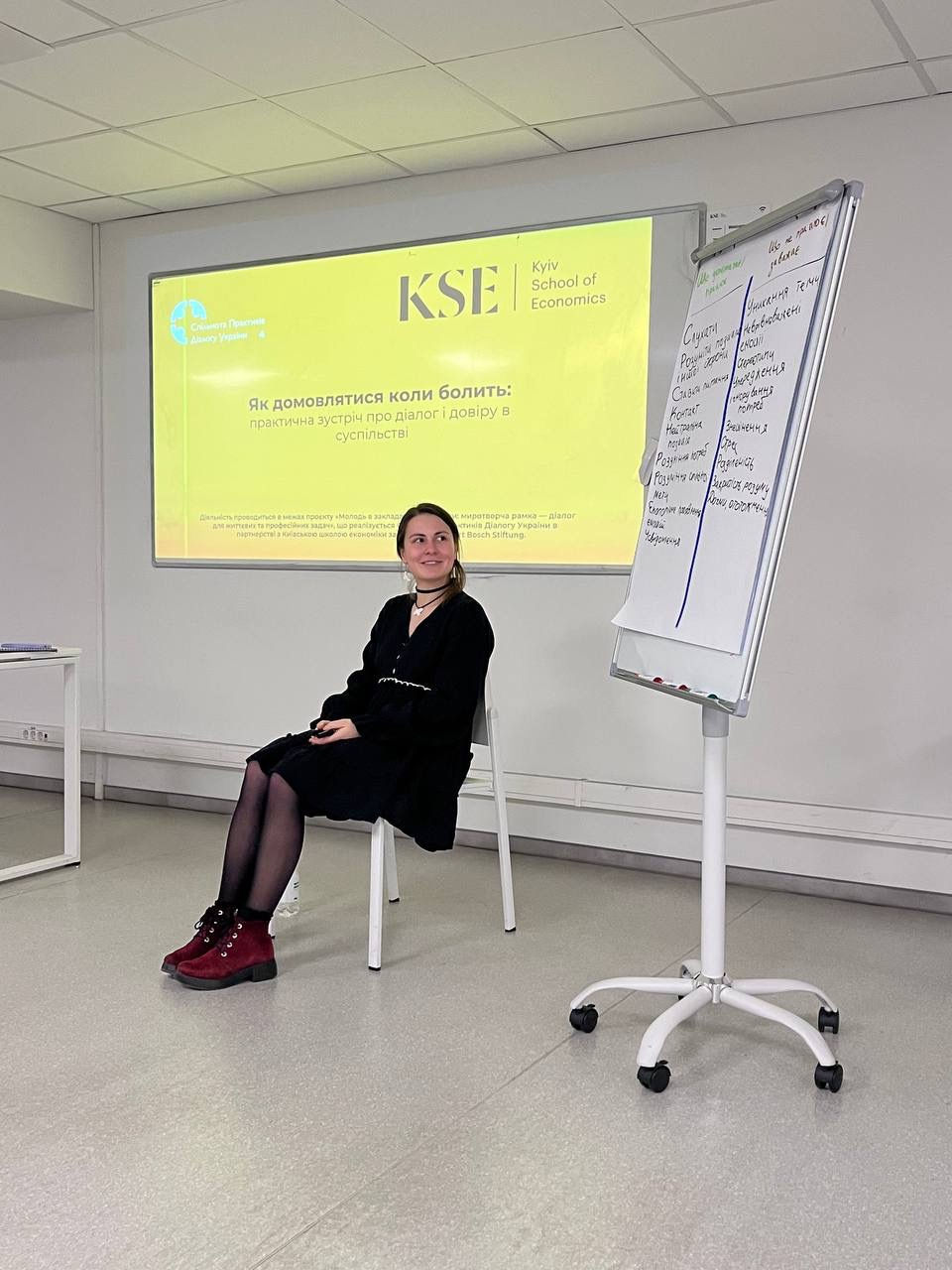
Participation in the Ukrainian Community of Dialogue Practitioners has become a powerful professional boost for Lisa. The Community is about the scale, where not only individual practices, but also more about changing the culture of communication and interaction at the country level. Thanks to cooperation with the Community, Lisa managed to realize a long-standing dream - to begin thorough work with universities to institutionalize restorative approaches. Cooperation has been established with two leading higher education institutions - the National University of Kyiv-Mohyla Academy and the Kyiv School of Economics (KSE). In the latter, thanks to a memorandum of cooperation, a certificate program in dialogue training is being implemented. In Mohylanka, work is carried out through the Mediation Service and the Student Affairs Department.

"These are universities where very active young people study, who tomorrow will work in the public and state sectors. They have a great influence on social change, because they are the ones who work with people and communities ," the specialist notes.
The community has become a powerful field of experts with vast experience and knowledge of international standards for Lisa. Being in the circle of practitioners, teachers, and those who influence the formation of public policies ensures constant methodological development. “We developed projects for young people together. Colleagues help with expertise, contacts, and approaches. This belief in me and expert support provide a resource for creating long-term changes — not just to conduct training, but to change the culture of the university as a whole.”
Another reason for the importance of working with universities is to expand the circle of specialists. Cooperation with youth attracts a new generation interested in dialogic approaches to volunteering, assisting, and coaching. Masters who already work in the public sector or NGOs generate new requests for facilitation. In the future, they will become the “young energy” that will continue and expand the work of the Community of Dialogue Practitioners of Ukraine, introducing a culture of peace at all levels and forming a new quality of interaction in society.


Comments